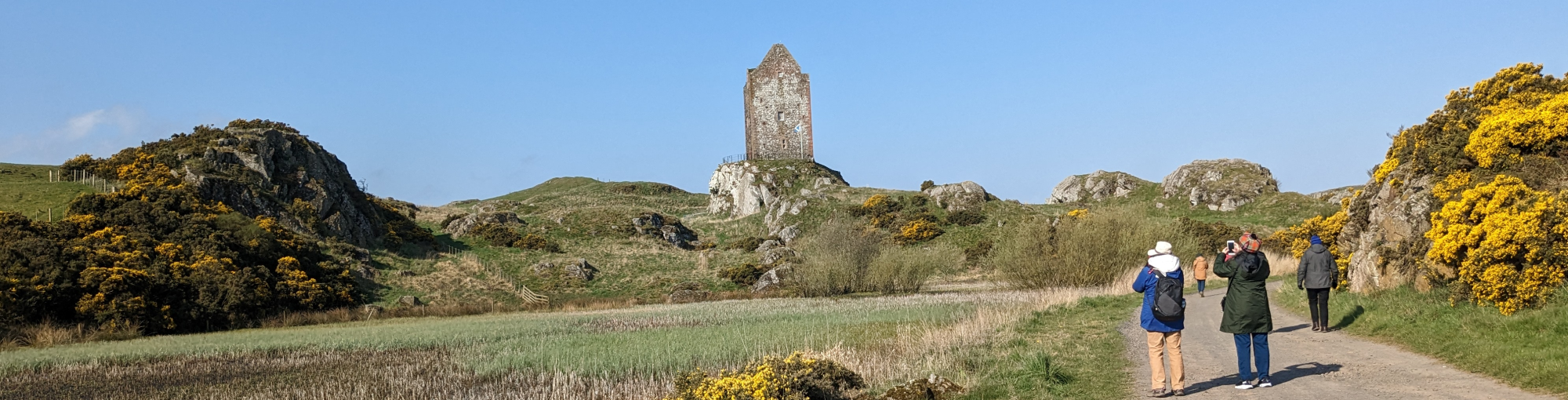

Scott McCracken is again leading the tour and his comprehensively informative guide to the places we’ll be visiting is a work of art. Since much of the tour focuses on fortified dwellings of one kind or another then our first outing obviously has to be to Edinburgh Castle so we set off in the coach at 9.15am. Scott – who clearly knows Edinburgh well – provides a running commentary on passing points of interest, notably the Walter Scott memorial. This is the first time the novelist has been mentioned, it certainly won’t be the last time we hear his name during the coming week.
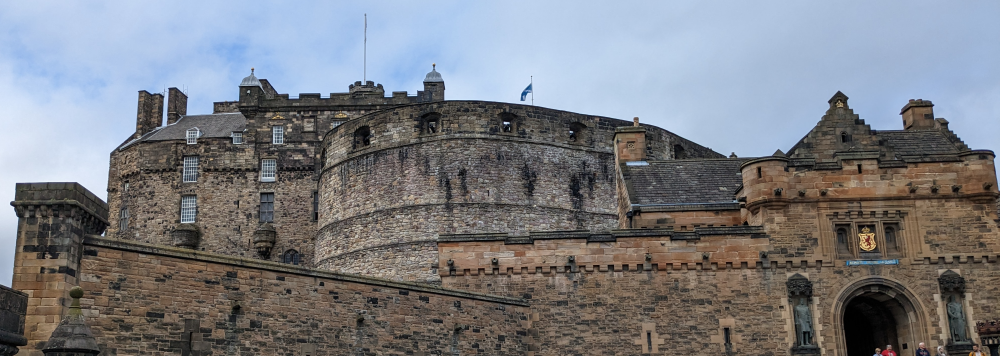
The castle dominates the city, perched here on Castle Rock , a volcanic plug dating from an eruption over 340 million years ago. Joining the other tourists surging up the steep path, we’re following the only accessible route to the top, the other sides being protected by sheer cliffs. This has been the site of a military base and fortified royal residence for centuries but the current castle was built by David I during the twelfth century.
Over the centuries ownership of the castle shifted between Scotland and England several times. ln 1571 English forces attempted to capture Mary, Queen of Scots (someone else whose name will crop up constantly). What became known as the ‘lang’ siege ended in February 1573 with the surrender of all Mary’s supporters. In 1650 Oliver Cromwell took possession of the castle during his invasionof Scotland in retaliation for its support of Charles II.
During the Jacobite Risings (1688-1746), the Scots mounted several unsuccessful attempts to recapture their castle. In 1745 an army led by Charles Edward Stuart (Bonnie Prince Charlie) captured the city for a few months but never managed to lay siege to the castle.
We gather near the gateway while Christine goes in search of tickets and Scott sketches out a few of the highlights inside the castle. He won’t be able to guide us inside the castle in ‘any roofed building’ as the explanatory leaflet puts it.
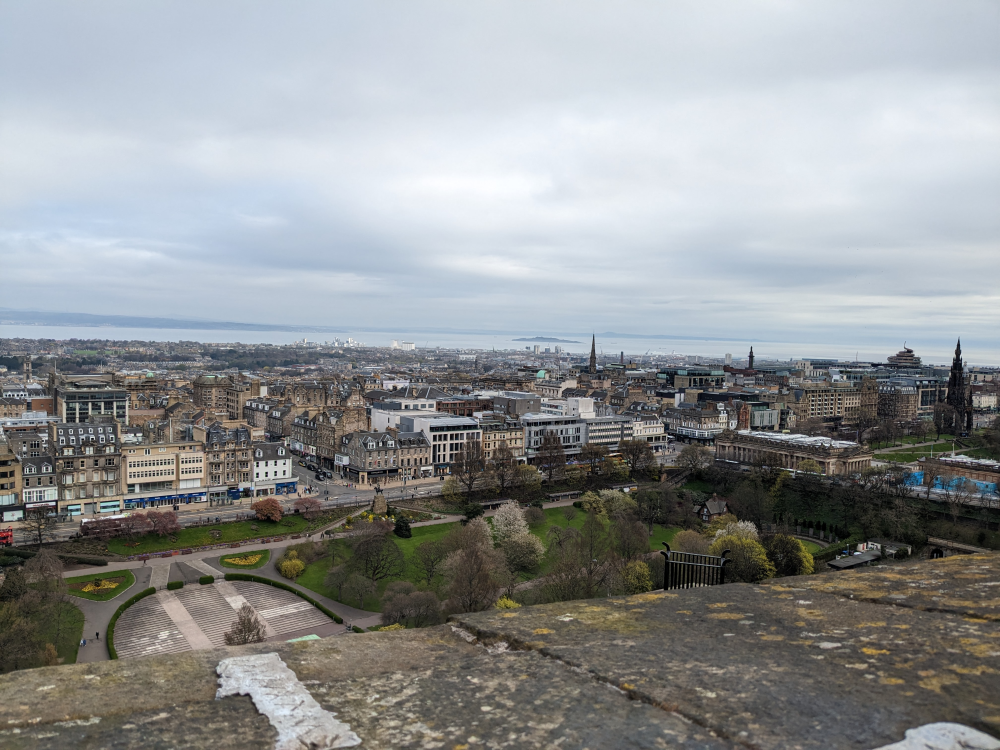
Inside at last we headed up to the top, so we could enjoy the view. As we looked out over Edinburgh I started to hear the distant sound of bagpipes. This noise would follow me round for the rest of the time I was inside the castle walls
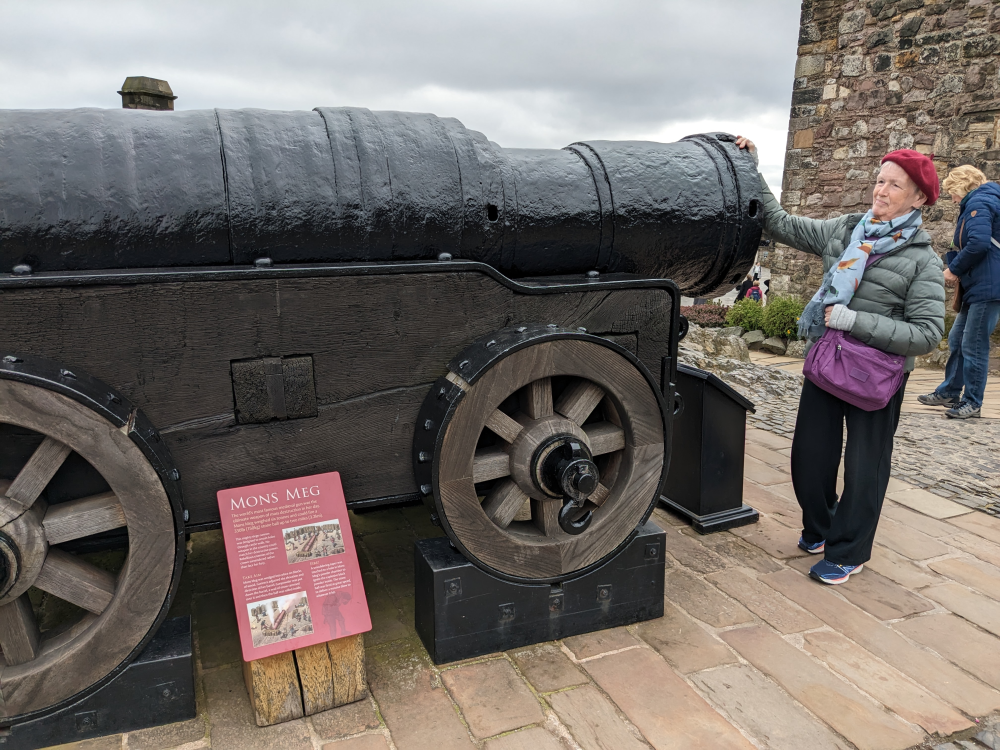
Our first task was to pay our respects to Mons Meg (above) one of the largest cannons built in the Middle Ages. Constructed around 1449 in Mons near Bruges it had a range of nearly two miles and could only be fired 8-10 times a day due to the tremendous heat generated by the powder charge required.
It was last fired on 14th October 1681 to celebrate the birthday of the Duke of Albany (later King James VII) when the barrel burst, ending its operational life. The gun was removed to the Tower of London in 1754 under the terms of the Disarming Act which aimed to curtail Jacobitism among the Scottish clans in after the 1715 Jacobite rising. It was strengthened after the 1745 Rebellion.
The gun returned to Edinburgh in 1828 by order of George IV, following a series of a series of campaigns led by Sir Walter Scott at its forefront. This is the first time the novelist has been mentioned but it won’t be the last.
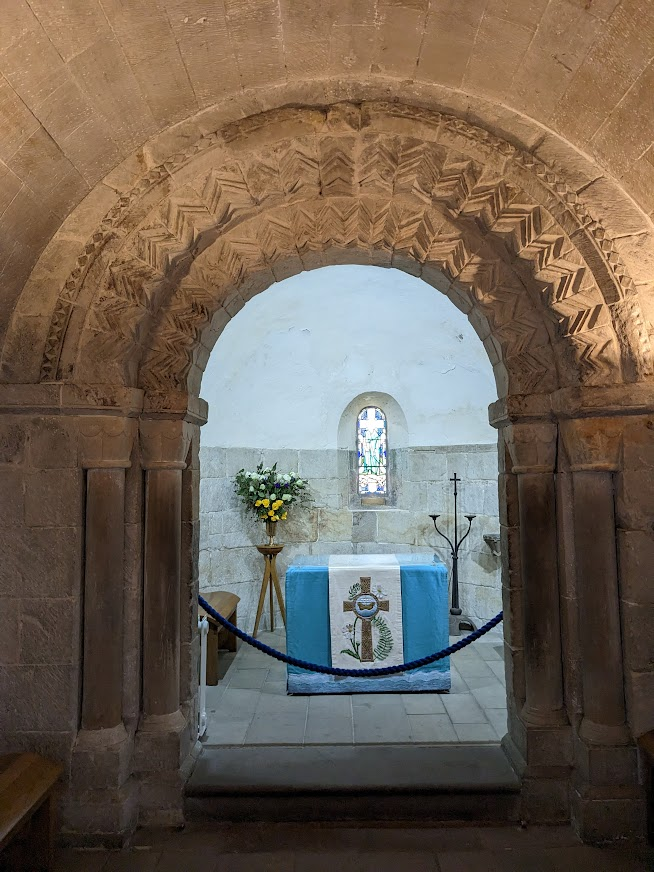
Few of the present buildings pre-date the Lang Siege when the medieval defences were largely destroyed. The most notable survivor is St Margaret’s Chapel (above) which is probably Edinburgh’s oldest building. Edinburgh. It may have been built by David I in memory of his mother, canonised as St Margaret in 1250. The building has been knocked about quite a bit since then and was used as a munitions store from the late 1500s until the mid-nineteenth century. In 1845 the buildings around it were demolished and it was partially restored with stained glass windows depicting Scottish saints added in 1930. It’s very atmospheric inside. Photography is not allowed but Angela managed to sneak this shot of the inner chapel.
It was tine to join the small queue waiting to go in and see the Honours of Scotland (the Scottish Crown jewels). It didn’t take long to get inside and it didn’t really take long to get a look at them. The Honours consist of the Crown of Scotland, the Sceptre, and the Sword of State. Other items such as Coronation robes, a pair of spurs, a ring and consort crowns were part of the regalia, but none survives today. Following the Union of 1707, the Honours were locked away in a chest in the Castle and were not rediscovered until 1818. The Honours are used at state occasions including the visit to Scotland by George IV in 1822 and the first visit to Scotland by Elizabeth II in 1953.
Also on display was the Stone of Scone, or the Stone of Destiny, shortly to leave for London for the coronation of Charles III.

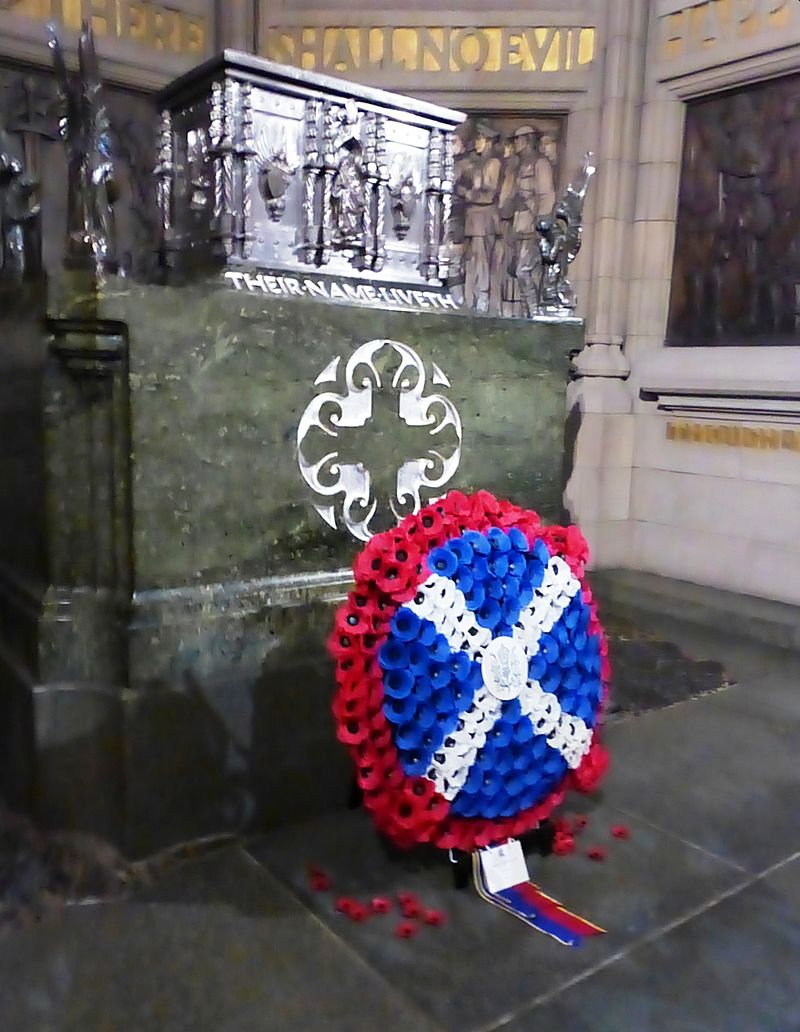
Our final stop while in the castle was the Scottish National War Memorial. After early – sometimes heated discussions – a plan to remodel the North Barrack Block was finally agreed in 1923, and the memorial was formally opened on 14 July 1927. It’s eerily quiet in here. Photography is strictly forbidden and visitors generally obey the request to walk round in reverent silence. Round the walls are elaborate monuments commemorating individual regiments. The Shrine (or Sanctuary) is a kind of side chapel which contains a sealed silver casket placed on the highest part of the Castle Rock emerging through the floor (below). This contains Rolls of Honour listing over 147,000 names of those soldiers killed in the First World War. The main Memorial had many more of these – including the names of more than 50.000 who died in the Second World War and later conflicts.

The Royal Mile is a succession of streets forming the main thoroughfare of the Old Townof Edinburgh. The term was first used descriptively in W. M. Gilbert’s ‘Edinburgh in theNineteenth Century’ (1901), describing the city ‘with its Castle and Palace and the royal mile between’. lt was further popularised as the title of a guidebook by R. T. Skinner pub-lished in 1920, ‘The Royal Mile (Edinburgh) Castle to Holyrood (house)’.
The Royal Mile runs between two significant locations in the royal history of Scotland, Edinburgh Castle and Holyrood Palace. The name derives from it being the traditional processional route of monarchs, with a total length of approximately one Scots mile or 1.81 Km, a now obsolete measurement. The streets which make up the Royal Mile are (west to east) Castlehill, the Lawnmarket, the High Street, the Canongate and Abbey Strand. The Royal Mile is the busiest tourist street in the Old Town, rivalled only by Princes Street in the New Town.
On the south side of the High Street, about one third of the way down from the Castle toward the Palace, is Parliament Square, named after the old Parliament House. This housed the law courts and the old Parliament of Scotland, between the 1630s and 1797 (when it’s existence was ended by the Act of Union). Parliament House now houses the Court of Session, Scotland’s supreme civil court. St Giles Cathedral, the High Kirk of Edinburgh, also stands in Parliament Square.
By the West Door of St Giles is the Heart of Midlothian, as described by Sir Walter Scott, being a heart shaped mosaic built into the ‘setted’ road. lt marks the site of the Old Tolbooth, formerly the centre of administration, taxation and justice, and prison, in the burgh. Since its demolition locals have traditionally spat upon the heart’s centre as a sign of contempt for the prison. On the north side, opposite St Giles, stands Edinburgh City Chambers, where the City of Edinburgh Council meets. On the south side, just past the High Kirk, is the Mercat Cross from which royal proclamations are read, and thesummoning of Parliament announced. The central focus of the Royal Mile is the major intersection between two importantbridges. North Bridge runs north over Waverley Station towards the New Town’s Princes Street. South Bridge (which appears at street level to be simply a road with shops on either side, with only one arch being visible from below), spans the Cowgate, a street to the south, and continues as Nicholson Street past the Old College building of the University of Edinburgh.
At John Knox’s House, the High Street narrows to a section of the street formerly known as the Netherbow, which, at its crossroads with Jeffrey Street (north) and St Mary’s Street (south), marked the former city boundary. At this point stood the Netherbow Port, a fortified gateway, in the Flodden Wall, between Edinburgh and the Canongate (until 1856 a separate burgh), which was removed in 1764 to improve traffic flow.
Brass studs in the road mark the gateway’s former position. The Scottish Storytelling Centre is a modern extension to John Knox House, owned by the Church of Scotland. It opened in 2006, replacing the former Netherbow Arts Centre, which itself replaced the Moray-Knox Church in the 1960s. Following the English victory over the Scots at the Battle of Flodden in 1513, the Flodden wall was built around Edinburgh, some parts of which survive today. On the corner of St Mary’s Street is the World’s End Pub which takes its name from the adjacent World’s End Close, whimsically so named because this was in former times the last close in Edinburgh before entering the Canongate.
Beyond the crossroads, the Royal Mile continues down the Canongate, eaning ‘the canons’ way’, when it was used in former times by the Augustinian canons of Holyrood Abbey. The street continues downhill past Moray House (now the main academic offices of Moray House School of Education, of the University of Edinburgh), the Canongate Tolbooth (now a museum of social history called The People’s Story), the Kirk of the Canongate (the Can0ngate’s parish church with a thriving Church of Scotland congregation), and the new Scottish Parliament Building, and then on to Holyrood Palace and the ruined abbey. Until 1856 the Canongate was not merely a street, but the name of the surrounding burgh, separate from Edinburgh and outside the Flodden Wall.
Abbey Strand is the short approach to Holyrood Palace situated at the foot of the Canongate. On the north side was the house of Lucky Spence, a notorious brothel madam, remembered in Allan Ramsay’s poem, Lucky Spence’s Last Advice. On the south side is the Queen’s Gallery, used to exhibit items, in the Royal collection, in the shell of the former Holyrood Free Church and Duchess of Gordon’s School. There are also the remains of the original gatehouse of Holyrood Palace built by James 1V. There is a copy of the royal coat-of-arms of James V set in its wall.
Then walked down onto the Royal Mile– past a lone piper – who I’d been hearing all morning. Edinburgh’s equivalent of a guitarist singing Bob Marley songs!
Visited St Giles Cathedral and inspected the Heart of Midlothian outside.
Patron saint of lepers
St Giles’ Cathedral, founded in 1124 by King David I, has been a working church for almost 900 years. A backdrop to Scotland’s turbulent religious history, it has seen the seeds of civil war sown and been John Knox’s parish church during the Reformation. It is still an important centre for civic services such as the Kirking of the Parliament and services for Most Ancient and Most Noble Order of the Thistle.
The church was first possessed by the monks of the Order of St Lazarus, who ministered among lepers.
1384, Scottish knights and barons met secretly with French envoys in St Giles’ and, against the wishes of Robert II, planned a raid into the northern counties of England.[47] Though the raid was a success, Richard II of England took retribution on the Scottish borders and Edinburgh in August 1385 and St Giles’ was burned. The scorch marks were reportedly still visible on the pillars of the crossing in the 19th century
Heart of Midlothian Football Club, commonly known as Hearts, is a professional football club in Edinburgh, Scotland. The team competes in the Scottish Professional Football League. Hearts, the oldest and most successful football club in the Scottish capital,[3] was formed in 1874, its name influenced by Walter Scott’s novel The Heart of Midlothian.[4] The club crest is based on the Heart of Midlothian mosaic on the city’s Royal Mile; the team’s colours are maroon and white.[
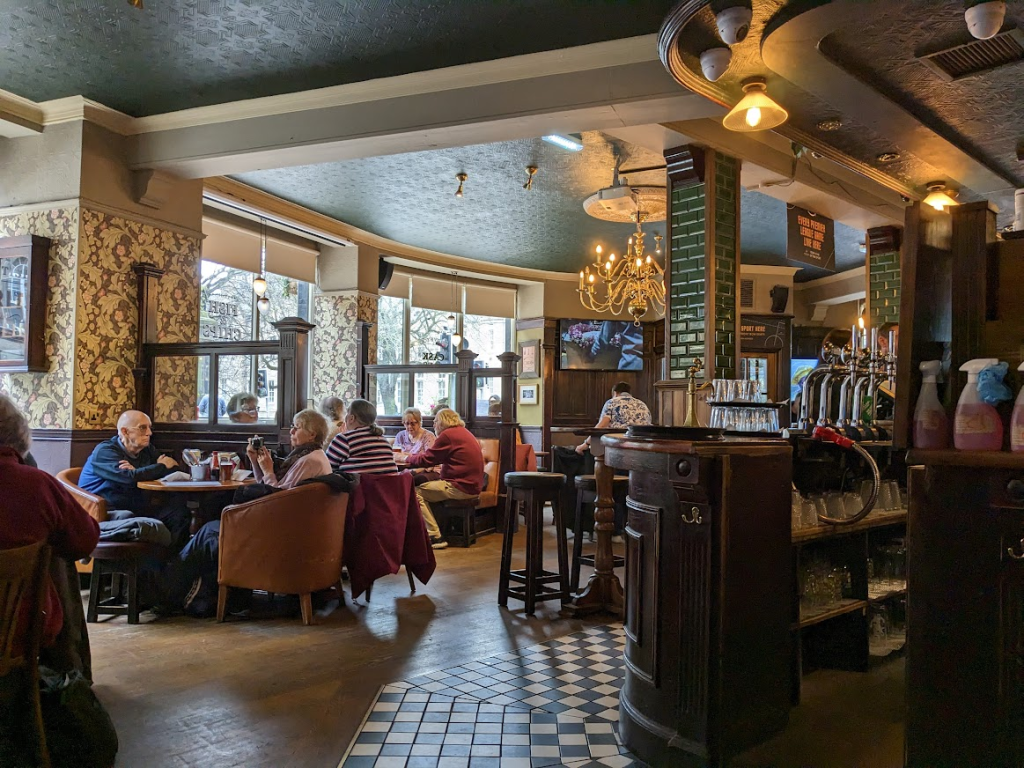
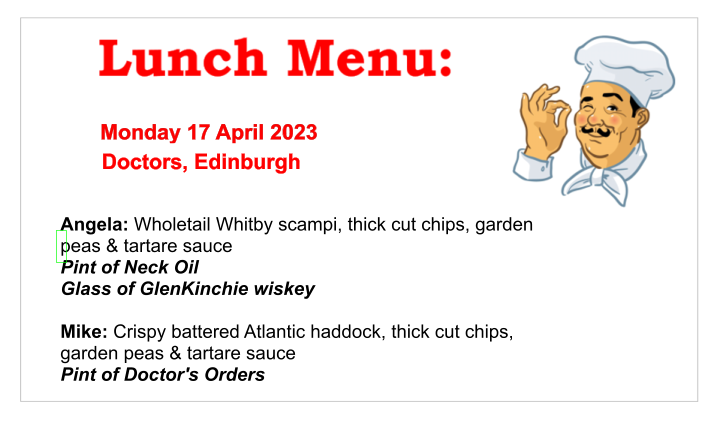
Weaving our way to Doctors Pub (below) passing our afternoon destination, the Edinburgh Museum, on the way
Edinburgh Museum
The afternoon was filled with a visit to the Edinburgh Museum a bit disappointing – badly signed – based on themes rather than chronology – but wandered round and saw movie which explained y question about the borderland landscape (Turns out it’s a result of tectonic plates colliding and throwing up mud the from the seas)– then walked up to top of museum and got as god view over the city, Scott’s notes had included highlights suggested by the museum few of which we saw. Some would have been good to see – [list] – other like a stuffed Dolly the Sheep
In the evening we had Scott’s talk about fortified houses