This morning we get to see the first of four abbeys on this trip. The weather is pretty much the same as it was yesterday, blue sky, and warm when you keep out of the fierce east wind. Out first stop is Melrose, around thirty-five miles away, so we settle back for around an hour to watch the passing countryside. There’s still a wintry look to the trees, with little sign of the greening up we’ve noticed in the warmer city.
We’re driving though mostly open fields behind walls and hedges dotted now and then with small woodland copses. We see a lot of sheep with their lambs, now entering the frisky stage, running, and jumping. And then we come down into Melrose itself.
The original Melrose was Magilros meaning “the bare peninsula” in Old Welsh. This referred to a neck of land by the River Tweed three miles east of the present town, where in the 6th century a monastery was founded by St Aedan of Iona, who also founded Lindisfarne. By 1124 when King David I took the throne that monastery and associated settlement had long been abandoned.
The king’s plan to create a new Cistercian monastery (the first in Scotland) on the original site was vetoed by the monks who preferred a site further west. Melrose Abbey was founded there in 1136, and the town of Melrose grew up around it. The abbey was badly damaged by Edward II’s army in 1322, and in 1385 it was largely destroyed by Richard II’s troops. Today, only a small part of the original church has survived.
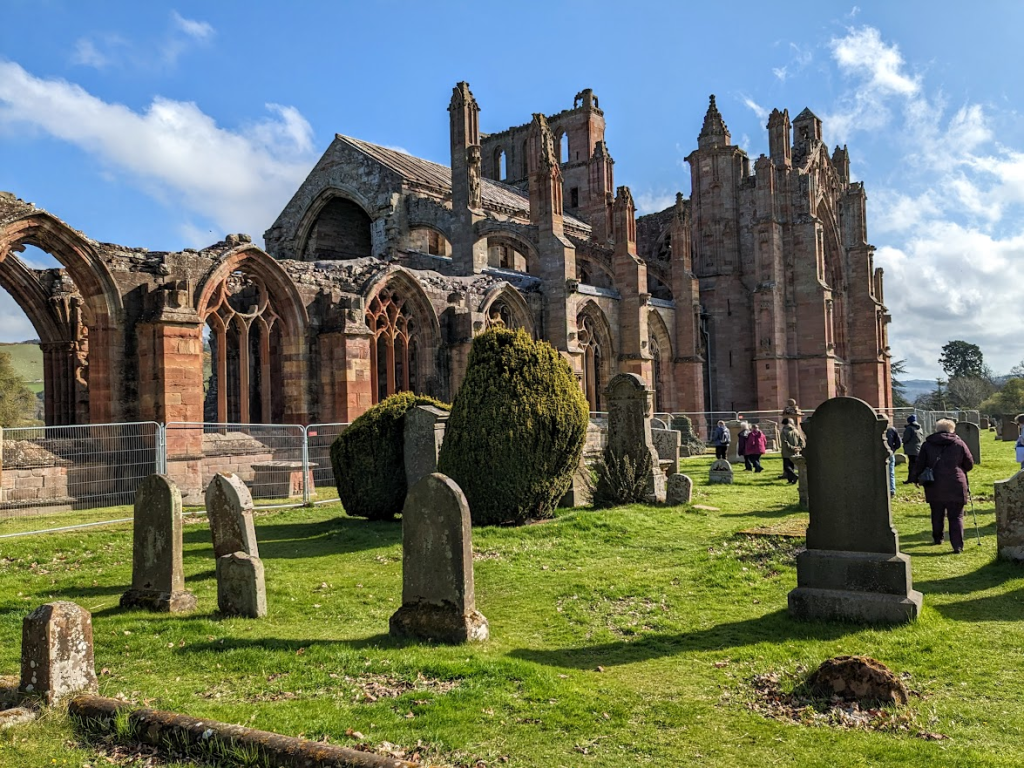
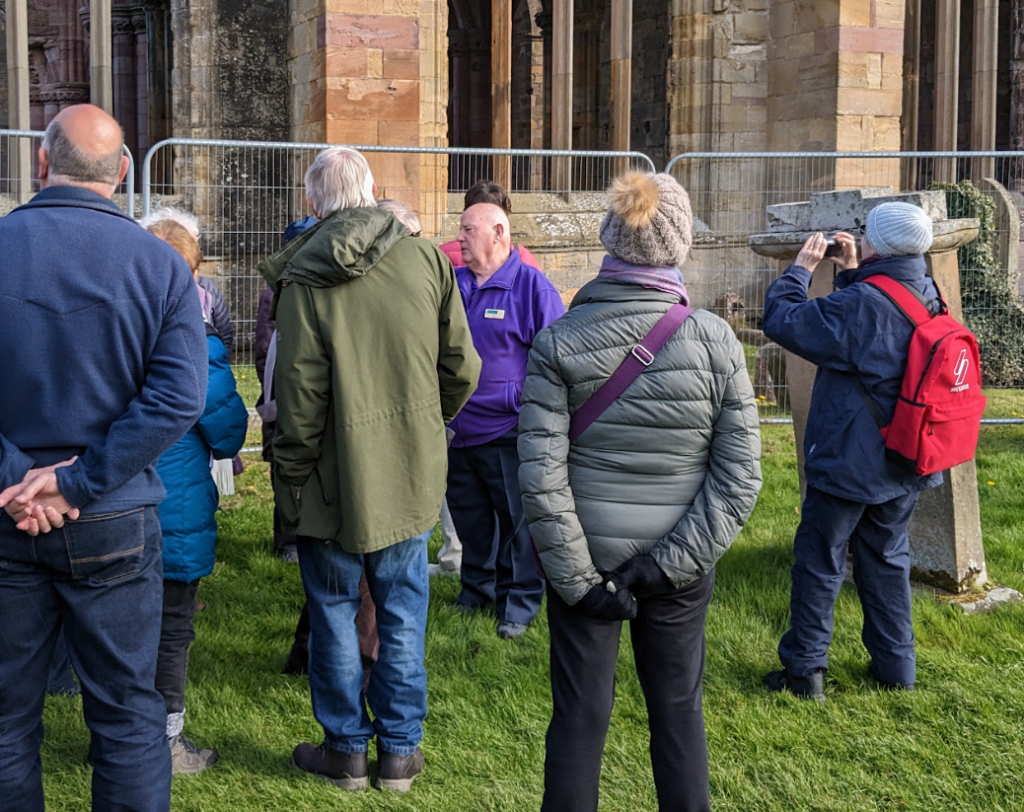
Unfortunately, we didn’t get a close look at it, as ongoing masonry repairs means that – in common with most places we visited – the abbey is inaccessible behind mental fencing. A very affable guide called Jim (pictured left, centre) took us for a tour round the edges.
Had we been able to wander insider the ruins we would have seen the spot where the heart of Robert Bruce is buried. Scotland’s national hero died in 1329, probably of leprosy. His body was buried at Dunfermline Abbey, but he had asked for his to heart be embalmed separately and buried at Melrose.
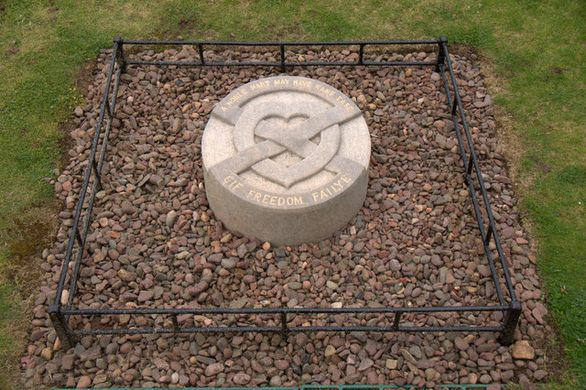
An urn containing an embalmed heart (presumably the Bruce’s) was discovered in 1920 and re-buried without a marker. During excavations of the abbey ruins in 1996 the urn was discovered and confirmed to hold the heart of Robert the Bruce. His heart was finally interred within the abbey walls, almost 700 years after he had initially requested it. A circular marker on the east side of the Abbey (right) marks the spot. Its inscription comes from John Barbour’s epic poem The Bruce : ‘A noble hart may have nane ease gif freedom failye.’ [A noble heart won’t rest easy if the fight for freedom is lost’]
The Reformation forced the Abbey into closure and eventual decay, but it’s still a striking structure with its lavishly decorated stonework. And over the years archaeological digs have unconverted the large extent of the abbey buildings and grounds.
Objects found during excavation are displayed in the museum based in the Commendator’s House which lays claim to having the largest collection of medieval artefacts on display anywhere in Scotland. The collectionffers a glimpse of what monastic life was like during the Middle Ages and many objects from the time have been preserved in the Abbey’s museum, from cooking pots to urinals.
kitchen range from the cloister. You then cross a minor road before passing through another gate. The Commendator’s House is obvious, being the only complete building in what is quite a large site. It is at about this point that you begin to realise just how enormous Melrose Abbey was in its prime. This part of the site has the very obvious foundations and column bases of the Lay Brothers’ Range, or the east range of the domestic accommodation. Anyone paying attention when wandering around the side of the site nearest the abbey will realise that this range continues all the way through, and was cut across by the much later road.
The Commendator’s House has stood in its present form since 1590, when it was converted to serve as a private residence for the James Douglas, the last commendator of the abbey. Commendators were lay administrators who, during the 1500s, increasingly supplanted abbots as the men in charge of abbeys. Their arrival was one of many indicators of the moral decline of abbeys across Scotland, itself a symptom of the wider malaise in the church that helped prompt the Scottish Reformation of 1560.
The post of commendator increasingly became a political one, often being awarded to the monarch’s favourites and often being seen as a means of allowing a powerful individual to tap into the wealth tied up in abbeys and priories. In many cases appointments continued to be made after the Reformation, and by the time James Douglas was appointed as commendator of Melrose Abbey it had virtually ceased to exist as a religious institution, and he would have been able to use its assets as he saw fit.
According to legend, Melrose Abbey has a stranger more demonic connection. The notorious wizard Michael Scott is said to be buried there with his books of magic. It’s not clear how one of the most celebrated monastic intellectuals of the 13th century gained this dubious reputation, but presumably medieval superstition and suspicion of arcane knowledge had a lot to do with it.
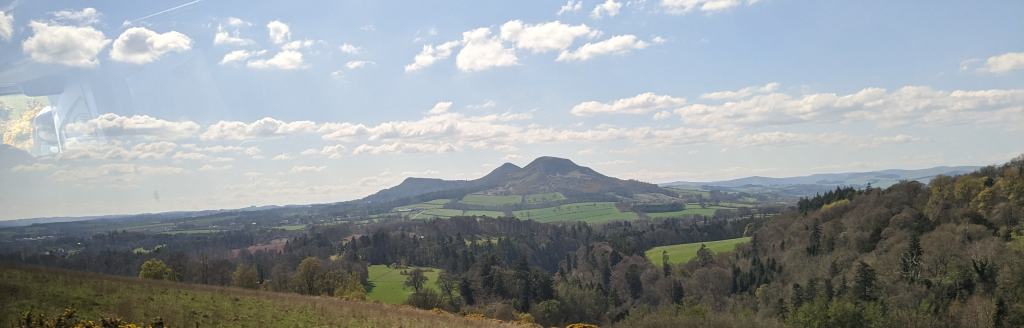
Possessing prophetic powers he’s supposed to predicted his own death – by a small pebble falling from the church ceiling on his unprotected head at he attended mass. But his greatest work towers to the south of Melrose: the Eildon Hills (above), which he is said to have split into the three peaks we see today and which brings us nicely to the Trimontium Museum.
Trimontium Museum tells the story of the Roman fort complex at nearby Newstead.
Trimontium was a frontier post at the outer limits of the Roman Empire, and served as a base for further incursions to the north. Rediscovered and excavated in the early 20th century, it has produced some of the finest Roman artefacts ever found in Scotland and is also home to the most northerly amphitheatre – so far – found in the Empire. The Trimontium Museum was established over 30 years ago to tell the story of the frontier post and its people, and put some of the finds on public display. Following major renovation and modernisation, the new Trimontium Museum reopened on August 2nd 2021. There are weekly guided walks to the fort site and around the town April- October. The Trimontium Museum is a voluntary organisation and welcomes new members to help us tell the story of our unique site.
There are at least two forts occupying the same site. The first fort was built during the first Roman forays into the Scottish Highlands, conducted by the intrepid governor Agricola , very likely during his 80AD campaign season.
The second occupation took place during the Antonine period. The garrison were presumably used to patrol the road far to the north and south, in order to maintain communications between the Legionary base at York and the newly-built Antonine Wall, between the Forth and the Clyde.
c.160-184AD: As the civilian population surrounding and supporting the fort diminished further the land that housed the annexes returned to a more natural state. The military presence reduced further, with the barrack block now housing the remaining soldiers and their families. The evidence points to the fort being deserted some time around 180AD. It is unclear whether the remaining civilian population left at this time or remained, outside or even inside the fort. Evidence does point to the potential use of early 3rd and late 4th century coins in the area (coins have been found to the south and to the west of Newstead village). Were the local population still engaged in a Romanised trade and economic pattern of behaviour?
Trimontium was a Roman fort complex in Scotland.[1] It is located at Newstead, near Melrose, in the Scottish Borders, in view of the three Eildon Hills which probably gave its name (Latin: trium montium, three hills).
Trimontium was about three times as big as any fort on Hadrian’s Wall and in the later period became the most northerly settlement of the whole Roman Empire. Trimontium is also considered of international importance as the site of one of the largest caches of Roman military objects in Britain, found in 117 pits.[3]
It was identified by Ptolemy in his Geography.[4]
The earliest modern reference to the archaeological significance of Trimontium stems from finds uncovered during mid-Victorian railway cutting works as part of the Waverley Line construction in 1846. As land to the east of the village of Newstead was worked, finds from pits full of Roman artefacts were uncovered.[11]
Excavations by James Curle between February 1905 and September 1910 began the first exploration of the site, making many findings.[12] These include foundations of successive forts described earlier, which throw much light on the character of this site, an unparalleled collection of Roman armour, including ornate cavalry parade (or ‘sports’) helmets,[13] horse fittings including bronze saddleplates and studded leather chamfrons, numerous artefacts associated with trade and manufacture, building & construction and daily life on the Roman frontier. In 1911 Curle published his archaeological findings in ‘A Roman Frontier Post and its People’. This remarkable volume quickly became a standard reference work, ahead of its time and still the most decisive work published in Scotland covering this period of Roman occupation, expansion and retreat.[11]
Sir Ian Richmond undertook small scale excavations and some re-interpretations of Curle’s work in 1947. At this time, with the advent and development of aerial photography as a tool in modern archaeological research, Dr J.K. St Joseph’s work at Trimontium revealed up to nine temporary encampments, evidenced through cropmarkings.[11]
In 1989 The Newstead Project began, a 5-year archaeological investigation undertaken by the Department of Archaeological Sciences of Bradford University. Initially under the direction of Dr. Rick Jones, and thereafter Dr. Simon Clarke, the project employed the most modern archaeological techniques to the Trimontium site for the first time. Clarke uncovered forty major archaeological features in his 1994 ‘rescue excavation’, including six deep pits containing a wealth of organic material. In 1996 he returned to the site to examine the suspected amphitheatre and suspected north annexe and in 1997 the Bradford University team completed the geophysics survey of the Trimontium site.[12]
Doctor John Reid Chairman of the Trimontium Trust gave us a brief talk about his own long term interests (from a boy) in Trimontium and his role in getting the trust set up and the museum built. While writing this I learned that he was awarded the MBE in the King’s Birthday Honours.
We are very proud to let you know that our very own John Reid has been awarded an MBE for his work in culture and heritage. It is very well deserved, not only for his long, steady and tireless leadership of Trimontium Trust that has led the refurbishment of the museum, building the HALO space and re-examining the fort site at Newstead, but also the work he initiates with partners to continually challenge our understanding and learn more about the period of our history we know he is passionate about – the Roman Iron Age.
The Ormiston, Melrose – home of the Trimontium Trust Roman Museum has been redeveloped and reopened August 2021.
The Trimiontium Trust run a museum local to the Trimontium site in the nearby town of Melrose. The museum’s £1.4 million redevelopment was part of a project supported by the National Lottery Heritage Fund to enhance and extend the galleries, displays and interpretation of Trimontium’s history. The trust carry out guided walks to the Trimontium site, run a lecture and talk series, undertake activities linked to local community events, and present school and family workshops.
Many of the original and later finds from Trimontium are of such quality and importance that they are displayed at the National Museum of Scotland in Edinburgh. Items such as the cavalry helmets and decorative face mask, horse chamfron, leather work and much else besides can be seen as well as other Roman finds.
The Trimontium Trust museum redevelopment project has seen key finds return to the vicinity of the original fort site & archaeological excavations. They are housed within this contemporary museum setting which extends, redesigns, reinterprets and re-displays objects telling the story of Trimontium and its relationship with the local population.

Dryburgh Abbey
Despite having been set on fire three times, the chapter house features paintwork that dates back to its construction and today boasts some of the best Gothic architecture in Scotland.
These graceful ruins became the burial place of David Eskrine, 11th Earl of Buchan in 1829, and three years later his friend Sir Walter Scott was also buried here. Also Duglas Haig (with a stadard war grave headstone as he requested) and his wife
Access to the property is through the main gates. It is a flat approach to the abbey, which can be entered without using steps. Most of the abbey, apart from the cloisters, is accessible.
There is a legend that the ruins of Dryburgh Abbey is the home of a benevolent spirit called Fat Lips. A woman who lost her lover in the 1745 Jacobite Rebellion made her home in the ruined abbey and claimed that Fat Lips, a little man in iron boots, used to tidy her cell for her.
https://en.wikipedia.org/wiki/Dryburgh_Abbey
A WARM SCOTTISH WELCOME TO DRYBURGH ABBEY HOTEL
Situated within 11 acres of private grounds on the banks of the River Tweed, the award-winning Dryburgh Abbey Hotel is a splendid baronial country house that dates back to the mid nineteenth century. Dryburgh Abbey Hotel offers comfortable accommodation in the heart of the Scottish Borders, and is a wonderful location in Scotland for leisure breaks, business events and weddings. The Hotel is only an hour drive from Edinburgh and Newcastle, and sits within easy reach of the Borders’ main attractions. The Hotel is located adjacent to Dryburgh Abbey, burial place of Sir Walter Scott. Apparently if you want a quiet Christmas (no party hats or games) this is the place to go! Saw a couple of fly fisherman taking advantge of the Tweed.
Lots of time to wander the grounds and walk down to the banks of the Tweed. (Angela learned here about Scott excavating the site where our flats were built – and the problems he and his teasm had from feral kids – especially around Bonfire Night)

Closure/restricted access:
https://blog.historicenvironment.scot/2022/08/a-monumental-challenge/