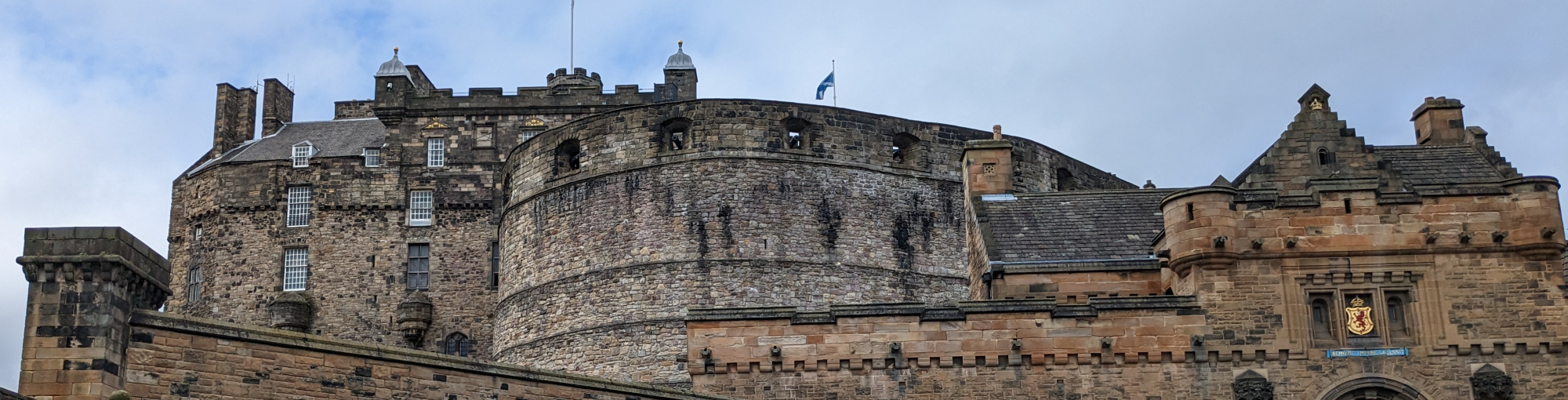

Our last day turned out to be very wet and chilly as we headed off on the long journey (over 60 miles) to visit Hermitage Castle which was key to the control of the Scottish Middle March, known as ‘the strength of Liddesdale’. The castle’s name probably derives from Old French for ‘guardhouse’: l’armitage. It was fought over time and time again and its turbulent history has led to it being dubbed ‘the guardhouse of the bloodiest valley in Britain’.
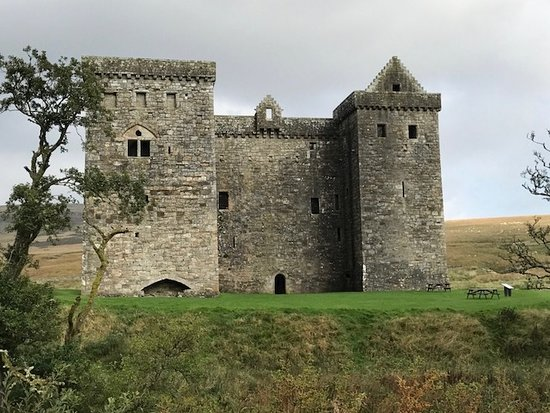
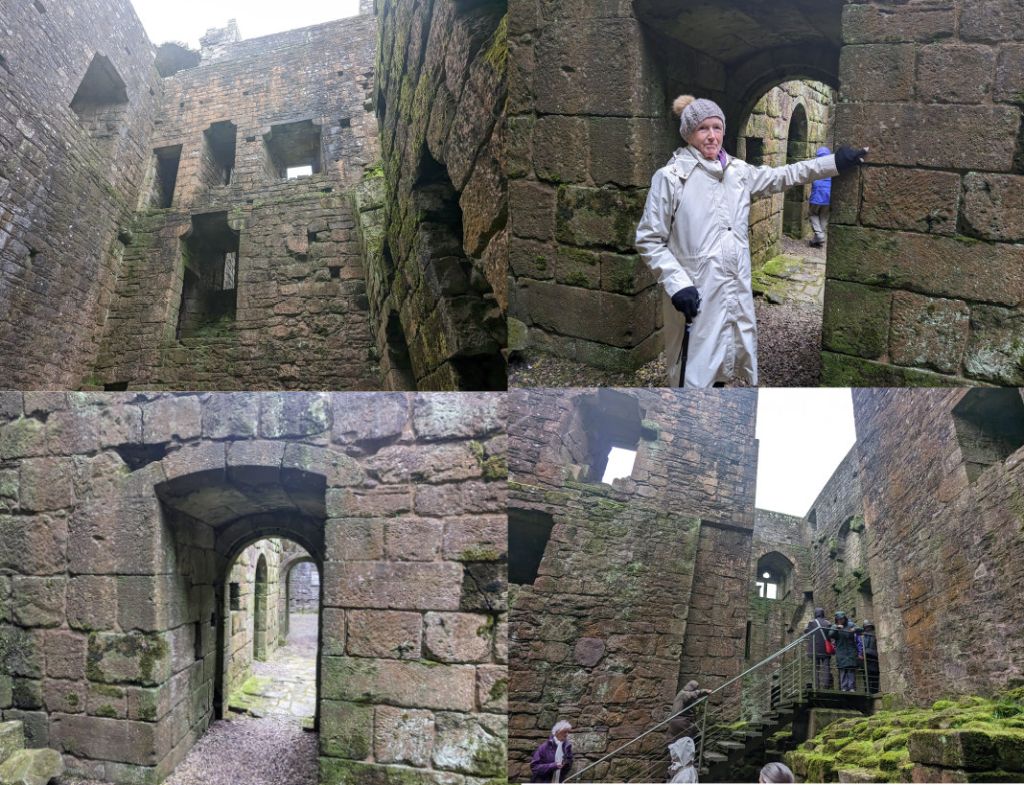
It’s certainly in an isolated location and is an impressive sight viewed from a distance as (in the pouring rain) we straggle up the hill towards it. From this angle it looks fairly well preserved, but this impression probably comes from its heavy restoration by the Victorians. Moving round to the other side, we find few signs of the dreaded Historical Scotland obstructive fencing, and we can get access within the ruins.
The earliest records show that it was originally a Motte and Bailey built for the de Soulis family in the 1240s. The English lord Sir Hugh de Dacre began building the present structure around 1360, but it was then transformed beyond recognition by his successor, William, 1st Earl of Douglas, one of Scotland’s most powerful noblemen.
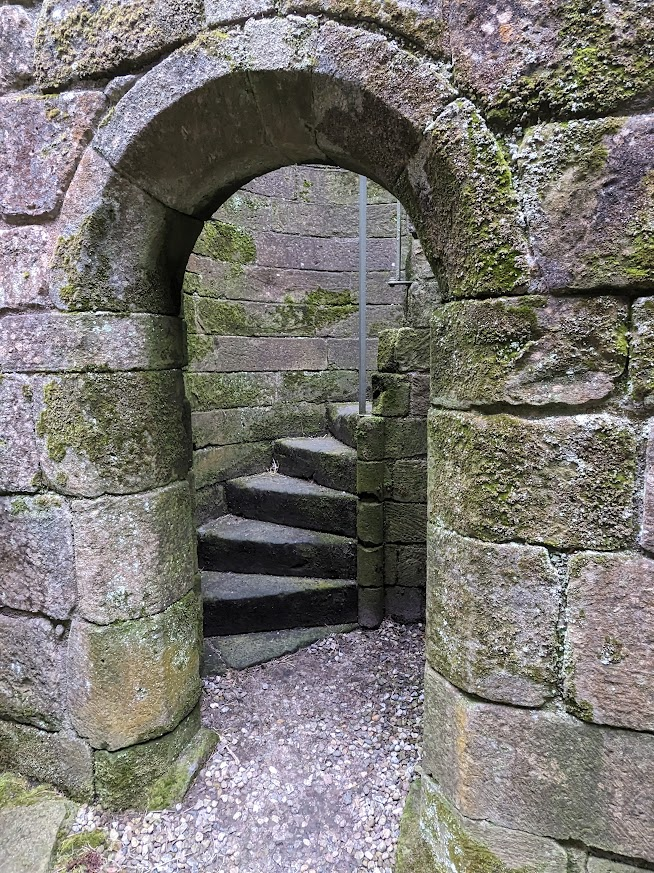
The 14th century structure was rectangular and enclosed a small central courtyard with an entrance in the south wall and a turnpike staircase opposite, which rises only to the first floor level. A rectangular tower house was built towards the end of the 14th century, which incorporated the earlier features.
Later massive rectangular towers were added to all but the southeast corner of the keep. The castle was now four stories high with a projecting battlement. In the 16th century, when firearms came to be used for defence, a few wide, oblong gun-loops were added to the outer walls.
At the end of the fifteeenth century King James IV fell out with the then owner Archibald Douglas Earl of Angus, suspicious of his relationship with Henry VII of England, and ordered him to hand over the castle to the Crown. It was then held under the stewardship of the Hepburns of Bothwell,
Naturally Mary Queen of Scots turns up in the castle’s story. In 1566 James Hepburn, 4th Earl of Bothwell, who held the castle was wounded in a skirmish with a band of reivers. Bothwell had met Mary in 1560 at the French Court when she was Queen of France. She obviously took to him giving him 600 Crowns and a paid job as a gentleman of the French King’s Chamber. The following. year King Frasncis II died and Bothwell helped organise the widowed Queen’s return to Scotland in a French galley,
Back at the Scottish court he was accused him of intriguing against the Crown bu caused some degree of anguish to the Queen, and although the Earl of Arran was eventually declared mad, Bothwell was nevertheless imprisoned in Edinburgh Castle without trial in 1562. Later that year, while the Queen was in the Highlands, he escaped and went to Hermitage Castle.[4]
The Queen and Bothwell were by now very close. When Bothwell married Lady Jean Gordon, daughter of The 4th Earl of Huntly, in February 1566, the Queen attended the wedding (the marriage lasted just over a year). In the following summer, upon hearing that he had been seriously wounded and was likely to die, she rode from Jedburgh to be with him at Hermitage Castle only a few weeks after giving birth to her son. However, historian Antonia Fraser asserts that Queen Mary was already on her way to visit Bothwell on matters of state before she heard about his illness, and that therefore this visit is not evidence they were already lovers at the time of his accident. Author Alison Weir agrees, and in fact the records show that Mary waited a full six days after learning of his injuries before going to visit Bothwell. The story of her mad flight to his side was put about later by her enemies to discredit her.
Mary, Queen of Scots, made a famous marathon journey on horseback from Jedburgh to visit the wounded Bothwell there, only a few weeks after the birth of her son. They were to marry shortly after the murder of her 2nd husband Henry Stuart, Lord Darnley, regardless of the fact that Bothwell was implicated amongst the conspirators. After Mary’s forced abdication following the confrontation at Carberry Hill, Bothwell, facing charges of treason, fled to Norway and his titles and estates were forfeited by Act of Parliament. Whilst attempting to raise an army to restore Mary to the throne, he was arrested by King Frederik‘s men for breach of marriage contract with Anna Throndsen, and imprisoned at Dragsholm Castle in Denmark, where he died insane and in appalling conditions. His mummified body could at one time be seen at nearby Fårevejle Church.
Naturally, Mary Queen of Scots turns up in the history of the place.. In October 1566, her trusted noble James Hepburn, 4th Earl of Bothwell, was wounded in a skirmish with reivers (cattle thieves). On hearing the news, Mary rode out from Jedburgh, a 25 mile journey across difficult terrain. It has been suggested that her two hour visit was a secret lovers’ tryst, with the man who later became her third husband. This was almost certainly malicious gossip, as their hasty courtship probably didn’t begin until the following year. On the gruelling journey back to Jedburgh, Mary’s horse stumbled, throwing her into a bog, from which she contracted a fever. She was confined to bed in Jedburgh for a week, and it was said that she was fortunate to recover from her ordeal.
Sir Walter Scott was also fond of this castle and had himself painted with it in the background.
I missed out on that 14th century Hermitage Chapel.
Hermitage lost its strategic importance in 1603, when Mary’s son James VI of Scotland also became James I of England. Abandoned by its noble owners, the castle was left to decay. In the 1800’s however, the new owner, the Duke of Buccleuch and Queensbury, was inspired to preserve the haunting ruin for posterity. This was possibly because novelist Sir Walter Scott had roused a spirit of nostalgia among Scots through his writings.
The castle remained a private property until 1930, when it was handed over to the care of the Nation. It is now looked after by Historic Environment Scotland: the castle together with a series of ancillary features is protected as a scheduled monument. These features include the ruins of a small chapel, possibly 14th century, set within a graveyard. More earthworks also lie to the west, which could be the site of an original castle, or they are a moated homestead of c 1300.
The castle is said to be haunted by Mary Queen of Scots. There are also hundreds of accounts of ghostly and other paranormal manifestations at Hermitage. These manifestations include children and adults crying, demonic laughter, and Robin Redcap, a demonic familiar or Goblin, called up by the first owner of the castle, William de Soulis.
The redcap familiar of Lord William de Soulis, called “Robin Redcap”, is said to have wrought much harm and ruin in the lands of his master’s dwelling, Hermitage Castle. Ultimately, William was (according to legend) taken to the Ninestane Rig, a stone circle near the castle, then wrapped in lead and boiled to death.[9] In reality, William de Soulis was imprisoned in Dumbarton Castle and died there, following his confessed complicity in the conspiracy against Robert the Bruce in 1320.
Sir Walter Scott in Minstrelsy of the Scottish Border records a ballad written by John Leyden entitled “Lord Soulis” in which Redcap has granted his master safety against weapons and lives in a chest secured by three strong padlocks.[10] Scott states that the Redcap is a class of spirits that haunts old castles, and that every ruined tower in the south of Scotland was supposed to have one of these spirits residing within.[
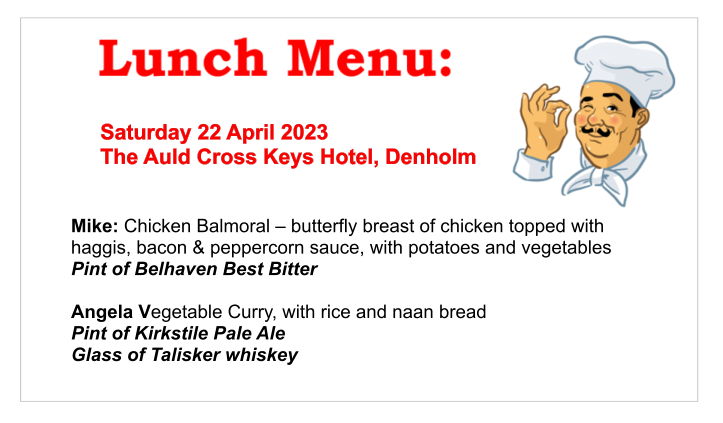
What looked like a relatively straightforward journey to our lunch stop at the Auld Cross Keys in Denholm turned into something of an epic as only a mile or so from the castle the coach hit a narrow bend over a bridge and despite his best efforts Carwyn was unable execute the turn and was forced to reverse almost the entire way back to the castle until he could turn the coach round. It was unnerving to say the least, and apparently quite upsetting to some of the others in the coach. Eventually we were able to head back on the direction we’d come, but it involved a long diversion.
At lunch – a lit lChristine did a quick check with everyone and then announced that because of the delay we were going straight back to the hotel. There was a bit of grumbling from a few people, but given the time it seemed like the right decision.
Lunch over and having seen that the rain had stopped we took a quick stroll round the village green, In Main Street, stands The Text House, a category B listed building, erected about 1910 by John Haddon (1845–1924), a medical doctor and author of published works on public sanitation and dietetics. The 3-storey house is in the arts and craft style. One of the texts on the front elevation is a reminder to take care with time before it passes, “TAK TENT IN TIME ~ ERE TIME BE TINT”, the other text reminds the occupier that there were and will be others living in the house, “ALL WAS OTHERS ~ ALL WILL BE OTHERS”
Evening we spent in bar with Marcia and Pamela.