
We set off in the coach at 9.30am which turned out to be the latest start we’d make during the week since Rosslyn Chapel was only about seven miles from the hotel. In fact we spent around half an hour waiting outside as we were too early for our tickets and had plenty of time to inspect the building from outside.
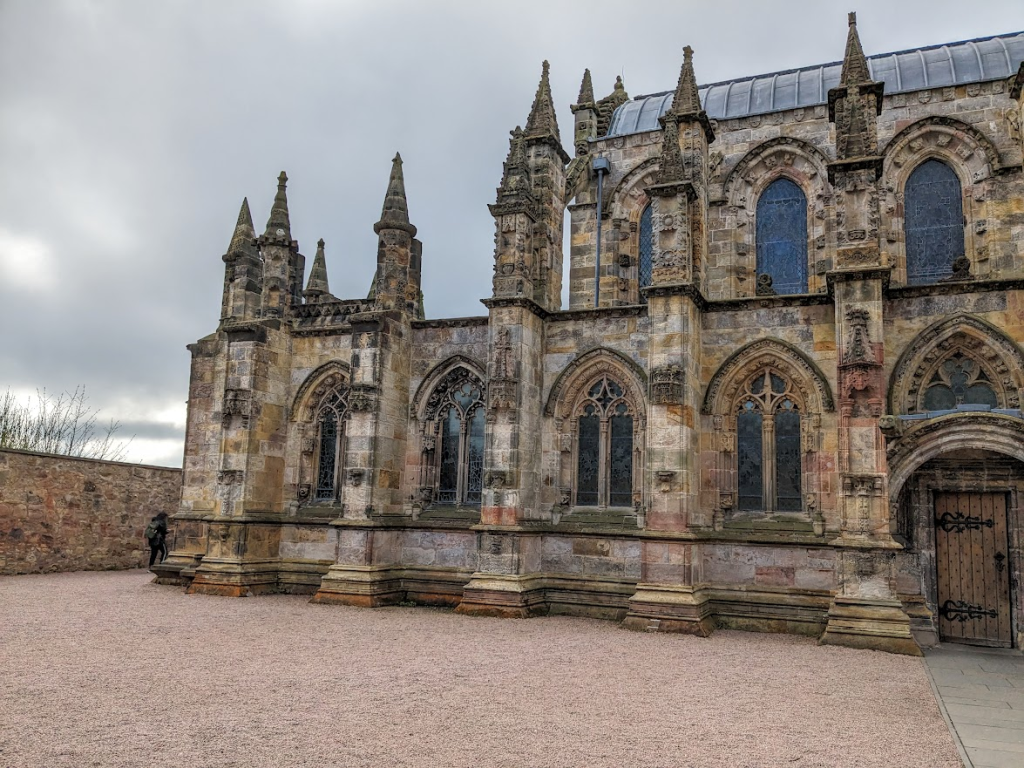
The chapel looks oddly unfinished. It was founded by Sir William Sinclair (3rd Prince of Orkney) and building began in 1446 and wasn’t completed until 1486. No plans have ever been found, but excavations since the 1800s have uncovered foundations extending a further 30 metres to the west, indicating the initial design was of a cruciform building – a full church complete with a steeple.
This is officially the Collegiate Church of St Matthew. A collegiate church is maintained by a college of canons, a community of ordained clergy. Such foundations this were intended to pray for the soul of the founder and to spread intellectual and spiritual knowledge.
The Scottish Reformation put a stop to that. in 1592 Oliver St Clair was ordered to destroy the altars of Rosslyn, which was as a ‘house and monument of idolatrie’. After the altars were destroyed, the Chapel ceased to be used as a house of prayer and subsequently fell into disrepair.
Cromwell’s troops stabled their horses here during their attack on Rosslyn Castle in 1650, and the chapel continued its decline, abandoned and overgrown. But Rosslyn’s extraordinary architecture and carvings have also inspired generations and meant its fame has endured over the centuries with visits from artists and poets helping to reinforce the romantic lure of this neglected ruin.
Robert Burns paid a visit in 1780, and Wordsworth with his sister Dorothy in 1803. He returned twice more, once sheltering during a storm inspiring him to write the sonnet – ‘Composed at Roslin Chapel during a Storm’. In 1805 Sir Walter Scott further enhanced the romantic myth with the ‘Lay of the Last Minstrel’, where he wrote about the legend that the chapel seems to be on fire on a night that a Rosslyn baron dies.
Since Queen Victoria declared the chapel as being in an ‘excellent state of preservation’ after her visit in 1842 it clearly wasn’t quite so ruinous at it might seem. A decade or so later James Alexander, 3rd Earl of Rosslyn commissioned the architect David Bryce to restore the fabric of the chapel and it was rededicated by on behalf of James Alexander, 3rd Earl of Rosslyn, made the Chapel useable again. Sunday services consequently began at the Chapel for the first time in over 200 years.
But it was expensive to maintain, and gradually the chapel began to show the signs of neglect and in the late 1990s the Rosslyn Chapel Trust began a major conservation project.
In May 2016 Elizabeth Quigley revisited the chapel for BBC Scotland after a ten year absence: “Back in the mid-2000s, the roof was covered to protect it from the elements and there was a small shop. I remember it was always cold inside the chapel, bitterly cold, even on a warm summer’s day. “
What was needed was another Lay of the Last Minstrel to help boost visitor income and Dan Brown’s mixture of history, myth, legend and fantasy set in real places provided the twenty-first century equivalent: “When I decided to write The Da Vinci Code, I knew that its finale would have to take place at the most mysterious and magical chapel on earth — Rosslyn.”
And the rest is genuine history. First the best-selling book, then the movie put the chapel on the tourist trail and a new visitor centre received a steady stream of visitors. which grew to over 176,000 at its peak, allowing the Trust to finish repairing the roof and complete its major conservation project.
Photography is not allowed inside the chapel and any illustrations of the interior are from the official website. Before the talk we were given by one of the chapel guides, we were allowed to wander round. There are carvings everywhere – human and animal figures, or foliage – which is unusual for late medieval Scottish architecture.
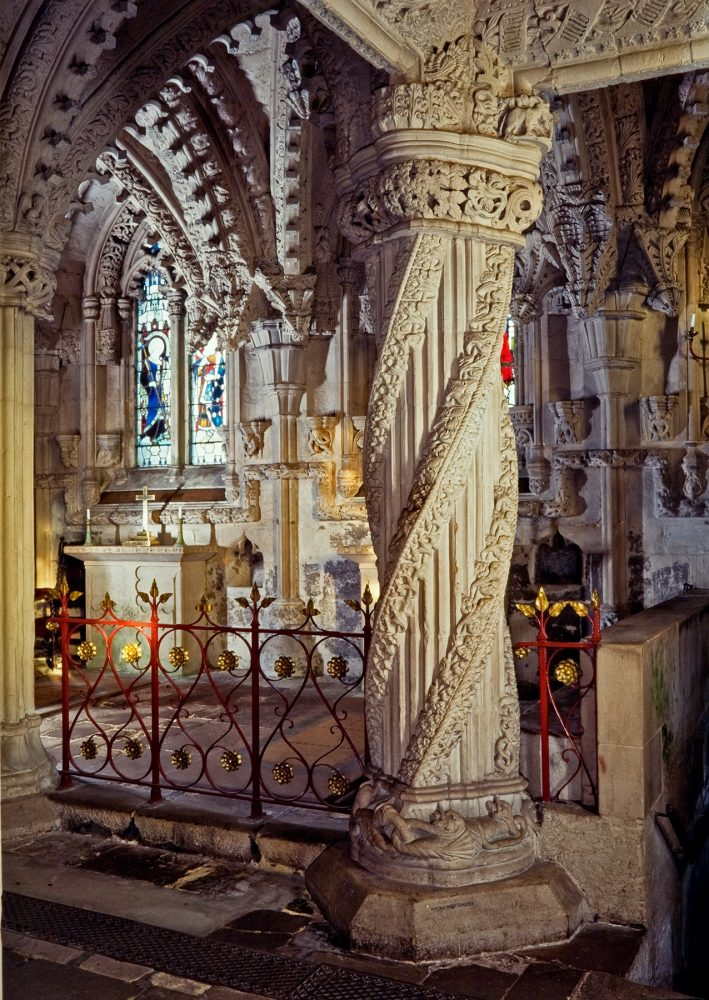
The best-known carving is the remarkable Apprentice Pillar. Made of sandstone it is ornately decorated with vines. The top of the pillar is covered with different plants, and there are eight dragons around the base. The unlikely legend has it that the pillar was carved by an apprentice while the the master mason while the master was away. Returning and overcome with jealous he killed the apprentice with a mallet.
He was hanged for his crime, and the other craftsmen carved a replica of the apprentice’s head, complete with the gash caused by the hammer, in a corner of Rosslyn Chapel. The master mason’s likeness was placed opposite the ornate Apprentice Pillar, where he would be forced to stare at its grandeur for the rest of time. These carvings are indeed there, but whether they came before the legend or afterwards we’ll never know.
Another legend claims that the Holy Grail is hidden in the pillar’s hollow centre. It’s not clear whether anyone has tried to test this exciting theory!
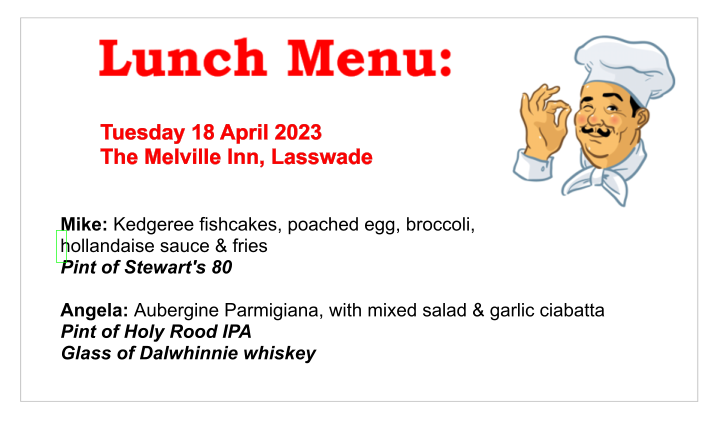
And it’s time to get back on the coach and on our way to lunch at the Melville Inn in Lasswade. It’s only just over four miles – mostly through woodland with some signs of greening up – so we’re there in under twenty minutes. the settlement may date back to the 8th century, the first written record of “Leswade” dates to 1150. The pub has the look and feel of a building a lot older than one which was only built in 2008.
Craigmillar Castle
After lunch it was a brief ride to Craigmillar Castle which certainly looked impressive as we approached. It was another This was where we came across the first of many signs and fences restricting access because a survey in 2021 had identified potential hazards to staff and public from fallen masonry and the programme of repairs was taking a long time to complete. Apparently HES was giving a discount to visitors to take this into account.
Craigmillar is one of the best-preserved medieval castles in Scotland. The central tower house, or keep, is surrounded by a 15th-century courtyard wall with “particularly fine”[3] defensive features. Within this are additional ranges, and the whole is enclosed by an outer courtyard wall containing a chapel and a doocot (dovecote). It started life in the 14th century as an L shaped tower house – a design making life difficult for attackers. The spiral staircases would be especially challenging but many of the intrepid EMAS party managed to get to the top and look out over the stunning views which would have afforded good warning of any approaching force.
Once we’ve arrived and gathered in front of the castle Scott gave us a brief ‘quiz’ based on his talk of the previous evening. The HES guide listened in surprise interest as this motley bunch of visitors let out a chorus of ‘machiolations’ when Scott asked about the defensive barrier around the edge of the battlements. He then chatted to us about the history of the castle – warning us not to take every assertion in the guide, or the explanataroty boards too seriously.
Craigmillar Castle began life, probably in the late 14th century, as a much simpler tower house. The lands of Craigmillar on which the castle now stands were first granted to the monks of Dunfermline Abbey in the reign of David I, with Sir Simon Preston acquiring the land in 1375.
The tower house, the oldest part of the castle, was probably built in the late 14th century by Simon Preston or his son Simon.
The structure was primarily designed and built for residential purposes rather than defence, however it was built on a rocky outcrop and did have a few defensive qualities designed to deter marauders from entering.
The house had a traditional manor house configuration with storage on the ground floor, a grand hall on the first floor and plush bedrooms and accommodation on the upper floors. Constructed in an ‘L’ shape, the entrance led onto a stairwell which provided access to all levels.
In 1544, Craigmillar Castle was caprtured by the English during the ‘Burning of Edinburgh’ in which Henry VIII and Edward Seymour, Earl of Hertford had attempted to force a marriage between the future Edward VI and Mary, Queen of Scots. A programme of repair and rebuilding in the 1550s included the construction of a new range of buildings along the east side of the inner courtyard. This was designed to provide more modern and spacious accommodation than was available in the tower house.
The castle would come to play host to the famous Scottish queen herself on two occasions. In March 1566, she fled to Craigmillar following the murder of her secretary David Rizzio at the Palace of Holyroodhouse. She also returned in the November of that year when the plot to murder her wayward husband Henry Stuart, Lord Darnley was hatched.
As Mary had already been Queen of France and Queen of Scotland many people thought that it would be unfair if she was not made Queen of England as well. […] Elizabeth, however, learning that in addition to all this Mary was good-looking and could play on the virginals, recognized that Mary was too romantic not to be executed, and accordingly had that done.
It seems unlikely that she kew nothing about this since she had made it clear that she had wanted to be rid of her second husband. Darnley was later found murdered on 9 February 1567 at Kirk O’Field, Edinburgh.
In 1660 the Prestons sold Craigmillar Castle to Sir John Gilmour distinguished judge and remained in his family for some time. Although Gilmour modernised much of the west range making it more suitable for family living, he finally moved to more comfortable surroundings at Inch House in nearby Gilmerton. Within a century it had become “a romantic ruin in the landscape“and in 1949 the Gilmour family entrusted it to state care.